MIG vs TIG vs Spot Welding for Fabricated Parts
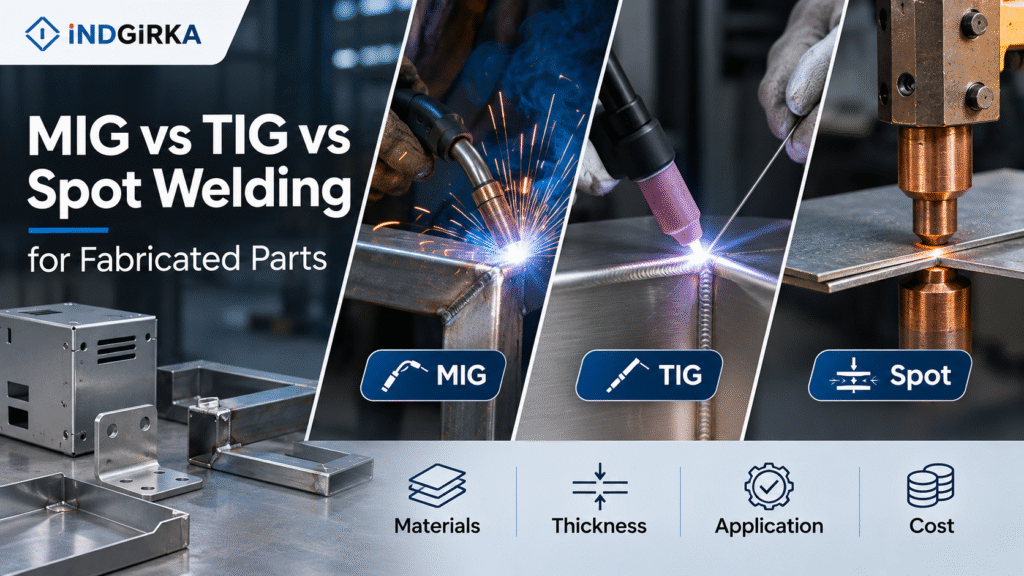
Choosing the wrong welding process can quietly add cost to a fabricated part. It can cause distortion, slow down production, or fail a corrosion or strength requirement months after delivery. For buyers searching for the best custom welded components Russia has access to, the process matters as much as the supplier. MIG, TIG and spot welding each suit different materials, thicknesses and volumes. This guide compares all three so you can write a better drawing note, ask better questions, and choose the right fabrication partner. Quick Comparison: MIG vs TIG vs Spot Welding Factor MIG (GMAW) TIG (GTAW) Spot (Resistance) Best for Structural frames, thicker steel, brackets Thin stainless, aluminium, visible joints Overlapping sheet, enclosures, panels Weld appearance Good, may need cleanup Excellent, very clean Small nuggets, minimal marks Speed Fast Slow Very fast Skill dependency Moderate High Low (process is automated) Filler material Yes (wire) Optional None Distortion risk Moderate Low Very low Cost per part Low to medium Higher Lowest at volume Typical thickness Medium to thick Thin to medium Thin sheet only What Is MIG Welding and Where Does It Fit? MIG (Metal Inert Gas) welding feeds a consumable wire electrode through a torch while shielding gas protects the weld pool. It is the workhorse of general fabrication. Strengths Limitations MIG is usually the right choice for machine frames, mounting brackets, structural supports and chassis. If you are comparing suppliers for the best custom welded components Russia industrial buyers can rely on, MIG capability with consistent weld procedures is a baseline requirement. What Is TIG Welding and When Is It Worth the Cost? TIG (Tungsten Inert Gas) welding uses a non-consumable tungsten electrode, with filler added by hand or machine where needed. It gives the operator very fine control over heat input. Strengths Limitations TIG is the right choice when appearance or leak-tightness matters. Examples include food-grade stainless enclosures, visible architectural parts, thin-wall tanks and precision assemblies. If a weld will be seen by an end customer, TIG is often worth the premium. What Is Spot Welding and Why Is It So Efficient? Spot welding is a resistance process. Two copper electrodes clamp overlapping sheets and pass a high current, fusing a small “nugget” at the contact point. There is no filler and no shielding gas. Strengths Limitations Spot welding is common in electrical enclosures, panels, brackets and housings. It pairs naturally with sheet metal fabrication, where parts are cut and formed from flat sheet before joining. How to Choose the Right Process for Your Part Use these five questions as a starting point. Many real assemblies mix processes. A common example is a spot-welded sheet metal body with a MIG-welded structural frame and TIG-welded stainless trim. Design Tips That Reduce Welding Cost Parts that need tight final tolerances after welding often combine fabrication with finish machining. Our guide to precision machined components in Russia explains how to source that second step, and our CNC machining buyer’s guide covers the machining side in more depth. Choosing a Supplier for Custom Welded Components in Russia A good supplier should be able to explain why they recommend a process, not just quote one. When evaluating partners for the best custom welded components Russia projects demand, ask about: You can read more about what to look for in our guide to choosing a sheet metal parts manufacturer. If your material is sheet steel, our article on steel sheet gauges and tolerances is a useful reference for specifying thickness correctly. To see the kind of parts we produce, browse our Parts Image Library, our products and the industries we serve. FAQ Which is stronger, MIG or TIG welding? Strength depends on joint design, material and weld quality more than the process itself. A properly made MIG or TIG weld can match the base metal. MIG is generally preferred for thicker structural work, while TIG is preferred where precision matters. Is spot welding strong enough for structural parts? Spot welding is strong in shear for thin overlapping sheets, which is why it is used in panels and enclosures. For heavy loads, thick sections or sealed joints, MIG or TIG is a better choice. Can aluminium be spot welded? Yes, but it needs specialised equipment because aluminium conducts heat and current very well. For most aluminium fabrications, TIG or MIG is the more practical choice. Which welding process is cheapest? Spot welding is typically cheapest per joint at volume, MIG is the economical all-rounder, and TIG costs the most because it is slower and more skilled. How do I get a quote for custom welded components? Send your drawing (PDF plus STEP or DXF), material, quantity and finish requirements. A good supplier will review manufacturability and suggest the most cost-effective welding process. Conclusion There is no single best welding process, only the best fit for your part. Use MIG for strong, economical structural work, TIG for precision and appearance on thin or specialty metals, and spot welding for fast, repeatable sheet metal assemblies. Looking for the best custom welded components Russia projects can depend on? Send us your drawings and our team will recommend the right process, review your design for manufacturability, and provide a quote. You can also contact us directly or explore our services.