Author name: admin@gmail.com

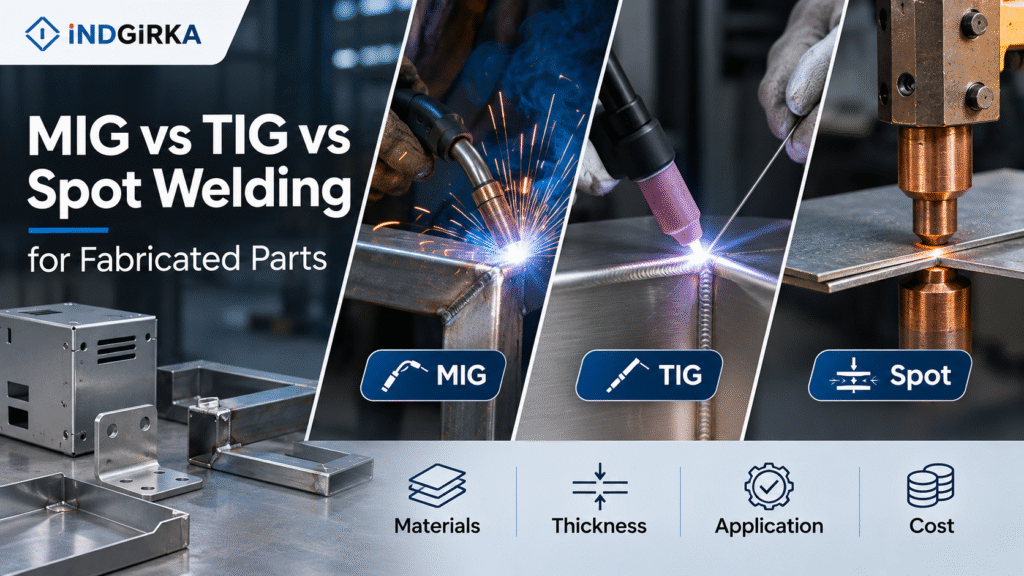
MIG vs TIG vs Spot Welding for fabricated parts – comparison of welding processes, techniques, and applications for custom welded components in Russia.
Off Road Febrication parts, Best Custom Welded Components

MIG vs TIG vs Spot Welding for Fabricated Parts

Choosing the wrong welding process can quietly add cost to a fabricated part. It can cause distortion, slow down production, or fail a corrosion or strength requirement months after delivery. For buyers searching for the best custom welded components Russia has access to, the process matters as much as the supplier. MIG, TIG and spot welding each suit different materials, thicknesses and volumes. This guide compares all three so you can write a better drawing note, ask better questions, and choose the right fabrication partner. Quick Comparison: MIG vs TIG vs Spot Welding Factor MIG (GMAW) TIG (GTAW) Spot (Resistance) Best for Structural frames, thicker steel, brackets Thin stainless, aluminium, visible joints Overlapping sheet, enclosures, panels Weld appearance Good, may need cleanup Excellent, very clean Small nuggets, minimal marks Speed Fast Slow Very fast Skill dependency Moderate High Low (process is automated) Filler material Yes (wire) Optional None Distortion risk Moderate Low Very low Cost per part Low to medium Higher Lowest at volume Typical thickness Medium to thick Thin to medium Thin sheet only What Is MIG Welding and Where Does It Fit? MIG (Metal Inert Gas) welding feeds a consumable wire electrode through a torch while shielding gas protects the weld pool. It is the workhorse of general fabrication. Strengths Limitations MIG is usually the right choice for machine frames, mounting brackets, structural supports and chassis. If you are comparing suppliers for the best custom welded components Russia industrial buyers can rely on, MIG capability with consistent weld procedures is a baseline requirement. What Is TIG Welding and When Is It Worth the Cost? TIG (Tungsten Inert Gas) welding uses a non-consumable tungsten electrode, with filler added by hand or machine where needed. It gives the operator very fine control over heat input. Strengths Limitations TIG is the right choice when appearance or leak-tightness matters. Examples include food-grade stainless enclosures, visible architectural parts, thin-wall tanks and precision assemblies. If a weld will be seen by an end customer, TIG is often worth the premium. What Is Spot Welding and Why Is It So Efficient? Spot welding is a resistance process. Two copper electrodes clamp overlapping sheets and pass a high current, fusing a small “nugget” at the contact point. There is no filler and no shielding gas. Strengths Limitations Spot welding is common in electrical enclosures, panels, brackets and housings. It pairs naturally with sheet metal fabrication, where parts are cut and formed from flat sheet before joining. How to Choose the Right Process for Your Part Use these five questions as a starting point. Many real assemblies mix processes. A common example is a spot-welded sheet metal body with a MIG-welded structural frame and TIG-welded stainless trim. Design Tips That Reduce Welding Cost Parts that need tight final tolerances after welding often combine fabrication with finish machining. Our guide to precision machined components in Russia explains how to source that second step, and our CNC machining buyer’s guide covers the machining side in more depth. Choosing a Supplier for Custom Welded Components in Russia A good supplier should be able to explain why they recommend a process, not just quote one. When evaluating partners for the best custom welded components Russia projects demand, ask about: You can read more about what to look for in our guide to choosing a sheet metal parts manufacturer. If your material is sheet steel, our article on steel sheet gauges and tolerances is a useful reference for specifying thickness correctly. To see the kind of parts we produce, browse our Parts Image Library, our products and the industries we serve. FAQ Which is stronger, MIG or TIG welding? Strength depends on joint design, material and weld quality more than the process itself. A properly made MIG or TIG weld can match the base metal. MIG is generally preferred for thicker structural work, while TIG is preferred where precision matters. Is spot welding strong enough for structural parts? Spot welding is strong in shear for thin overlapping sheets, which is why it is used in panels and enclosures. For heavy loads, thick sections or sealed joints, MIG or TIG is a better choice. Can aluminium be spot welded? Yes, but it needs specialised equipment because aluminium conducts heat and current very well. For most aluminium fabrications, TIG or MIG is the more practical choice. Which welding process is cheapest? Spot welding is typically cheapest per joint at volume, MIG is the economical all-rounder, and TIG costs the most because it is slower and more skilled. How do I get a quote for custom welded components? Send your drawing (PDF plus STEP or DXF), material, quantity and finish requirements. A good supplier will review manufacturability and suggest the most cost-effective welding process. Conclusion There is no single best welding process, only the best fit for your part. Use MIG for strong, economical structural work, TIG for precision and appearance on thin or specialty metals, and spot welding for fast, repeatable sheet metal assemblies. Looking for the best custom welded components Russia projects can depend on? Send us your drawings and our team will recommend the right process, review your design for manufacturability, and provide a quote. You can also contact us directly or explore our services.
Blog, Galvanized Steel Sheets

Steel Sheet South Africa: Materials, Gauges and Tolerances for Sheet Metal Parts

Steel Sheet South Africa buyers need to consider three important factors before ordering sheet metal parts: material, thickness (gauge) and tolerance. These specifications affect how accurately a part fits, how long it lasts and how much it costs. Choosing the right steel sheet for your project can help reduce manufacturing errors, prevent rework and save money. This guide explains different sheet metal materials, gauges and tolerances, helping South African buyers make informed decisions when ordering steel sheet parts. Steel or stainless steel: which should you choose? Mild (carbon) steel is the most common choice for structural, automotive and general industrial parts. It is strong, easy to form and weld, and cost-effective. Its main weakness is corrosion, so it usually needs painting, galvanising or powder coating for outdoor or humid use. Stainless steel resists rust and staining much better, which makes it suitable for food equipment, water-facing components, hygienic environments and outdoor enclosures. It costs more than mild steel and can be harder to form, but it often needs less maintenance over its life. As a simple rule, use mild steel for internal or painted parts where cost matters, and stainless steel where corrosion resistance or appearance is important. Your fabricator can advise on the grade that suits your application, including whether a coating is needed. Understanding sheet metal gauges Sheet thickness is usually given as a gauge number. The rule that trips people up is that a higher gauge number means thinner sheet. A 10-gauge sheet is thicker than a 16-gauge sheet. Approximate thicknesses for mild steel, using the common Manufacturers’ Standard Gauge: Gauge Approx. thickness (mild steel) 10 3.42 mm 12 2.66 mm 14 1.90 mm 16 1.52 mm 18 1.22 mm 20 0.91 mm Stainless steel gauges do not match mild steel exactly, so always check the gauge chart for the specific material. Also confirm whether your drawing gives thickness in millimetres or gauge. Many drawing errors come from mixing the two. What tolerances mean for your parts A tolerance is the permitted variation from the dimension on your drawing. Tight tolerances improve fit and accuracy, but they usually increase cost and inspection time. Loose tolerances are cheaper, but they may cause assembly problems. Typical considerations include: Only specify tight tolerances where the function requires them. A good practice is to mark critical dimensions on the drawing and use standard tolerances for everything else. If you are unsure, ask your fabricator to review the drawing before production. Tips for ordering steel sheet parts in South Africa Where to get sheet metal parts made If you need a manufacturer that handles the full process, Indgirka produces sheet metal parts for prototypes, low-volume runs and high-volume production. Their services include CNC laser cutting, bending, welding and machining, with coating and assembly under one roof. You can also browse their parts image library to see examples of components before you send your own drawings. Indgirka lists ISO 14001, ISO 45001 and IATF certificates on its homepage, and its industry page covers the sectors they serve. If you are sourcing outside India, confirm with them directly that they can supply to South Africa, including shipping costs and delivery times. You can request a quote or contact the team with your drawing and specifications. For other processes, see their pages on casting and forging parts and rubber and plastic parts. Final thought Getting steel sheet right comes down to three decisions: the material, the gauge and the tolerance. Make them clearly, share a complete drawing with your supplier, and ask questions before production starts. That approach reduces errors, avoids rework and gets you parts that fit the first time. Note: Gauge thickness values are general reference figures. Check the exact specification with your supplier before production. Confirm all certifications, lead times and South African delivery details directly with the manufacturer

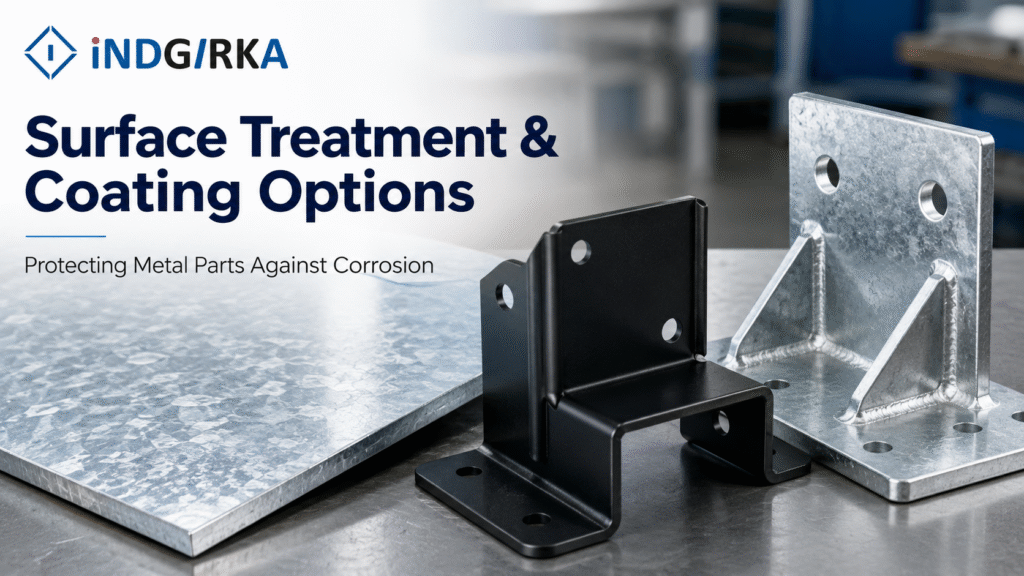
Surface treatment and coating options for metal parts, featuring galvanized steel sheets and powder-coated metal brackets for corrosion protection.
Uncategorized

Surface Treatment & Coating Options for Metal Parts

Surface treatment is essential for protecting metal parts from corrosion, rust and environmental damage. Australia’s coastal salt air, strong UV exposure and humid northern climate can corrode unprotected steel quickly, making the right coating important for long-lasting durability. This guide explores the main surface treatment and coating options, with a focus on galvanized steel sheet for Australian buyers. Why Surface Treatment Matters Bare steel rusts when it meets moisture and oxygen. A coating or treatment slows this by acting as a barrier, by sacrificing itself to protect the steel, or both. The right choice also affects appearance, wear resistance, weldability and cost. The best option depends on three things: where the part will be used, how it is made, and what it must look like. Galvanized Steel Sheet: The Starting Point Galvanizing coats steel with zinc. Zinc protects in two ways: it forms a barrier layer, and it corrodes first (sacrificial protection), which helps protect small scratches and cut edges. For sheet metal, there are two common routes: For Australian projects, check the applicable standards with your supplier, such as AS 1397 for zinc-coated sheet and AS/NZS 4680 for hot-dip galvanized fabricated articles. Other Coating Options for Metal Parts Galvanizing is not the only answer. Here is how the main options compare. Treatment How it works Best for Watch out for Pre-galvanized sheet Zinc applied at the mill Indoor and mild outdoor sheet metal parts Cut and welded edges lose the factory coating Hot-dip galvanizing Part dipped in molten zinc Outdoor, structural, high-corrosion use Size limits, possible distortion on thin parts Electro-galvanizing / zinc plating Thin zinc layer by electroplating Fasteners, small precision parts Thinner protection than hot-dip Powder coating Dry powder applied, then baked Colour, uniform finish, good durability Needs proper pretreatment for adhesion Wet paint Liquid paint, often over primer Large parts, custom colours Needs good surface prep, can chip Zinc-aluminium coated sheet Zinc-aluminium alloy coating Roofing, panels, harsher environments Edge performance varies by product Anodizing Oxide layer on aluminium Aluminium parts needing wear and looks Only for aluminium Black oxide / phosphating Thin conversion coating Tools, machine parts, paint base Limited corrosion protection alone Passivation Chemical cleaning of stainless Stainless steel parts Not a visible coating Duplex Systems: Galvanizing Plus Powder Coating For demanding environments, many buyers combine zinc with a paint layer. The zinc handles corrosion, while the powder coat adds colour and an extra barrier. This pairing can extend life noticeably, especially in coastal and industrial zones. Proper surface preparation between the two steps is essential, or the paint may peel. How to Choose the Right Coating Work through these questions in order: Design Tips for Coated Sheet Metal Parts Small design choices improve coating results: Safety note: Welding or cutting galvanized steel releases zinc fumes. Use good ventilation and appropriate protective equipment. Sourcing Coated Metal Parts When you buy fabricated parts, ask your supplier about coating options before the design is final. Indgirka offers sheet metal fabrication with hardening and coating handled alongside cutting, bending, welding and machining, so surface treatment can be planned as part of the manufacturing process. You can view our services, browse sheet metal parts, see samples in the parts image library, or check the industries we serve. If you want to know more about the company, visit the About page or read more on the Indgirka blog. FAQ What is galvanized steel sheet? It is steel sheet coated with zinc to resist rust. The zinc forms a barrier and also protects the steel sacrificially. Is galvanized steel suitable for coastal Australia? It can be, but coastal areas are tough. Heavier zinc coatings or a duplex system (galvanizing plus powder coating) often last longer than a basic coating. Can you powder coat galvanized steel? Yes, with correct cleaning and pretreatment. This combination is widely used for better durability and colour. What does Z275 mean? It is a zinc coating weight designation. A higher number means a heavier coating and generally longer protection. Is hot-dip galvanizing better than pre-galvanized sheet? For outdoor and structural parts, hot-dip usually gives heavier protection. For light indoor parts, pre-galvanized sheet is often enough and more economical. Conclusion There is no single best coating. Match the treatment to the environment, the part’s function and your budget, and plan it early in the design stage. For custom parts with the right surface finish, share your drawings and requirements with the team. Get in touch with Indgirka

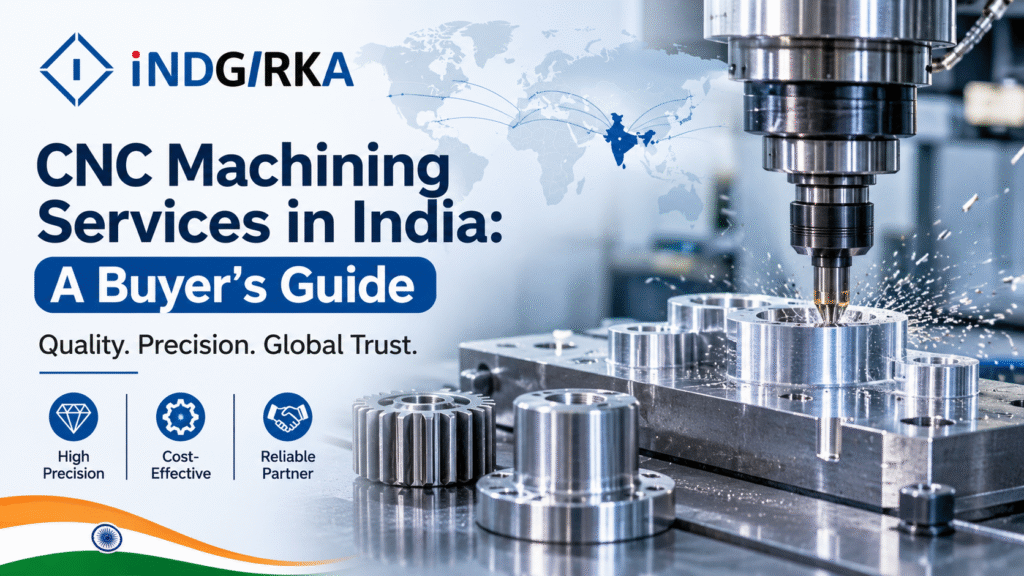
CNC machining services in India for precision metal component manufacturing
CNC Machined Components, Blog

CNC Machining Services in India: A Buyer’s Guide

India has become a trusted source of precision machined parts for buyers in the United States, Germany, Canada, Australia and Brazil. Skilled engineers, a deep metal supply chain and competitive pricing make it attractive, but quality differs widely between suppliers. This guide explains what CNC machining services in India cover, what to send with your enquiry, and how to pick a partner you can rely on. What Are CNC Machining Services? CNC (Computer Numerical Control) machining cuts parts from solid metal using computer-controlled tools that follow your CAD model or drawing. Because the machine repeats the same programme every time, part number 1,000 matches part number 1. The main processes are: Why Source CNC Machined Parts From India? Engineering talent. Many Indian workshops work comfortably from international drawings and GD&T callouts. Competitive total cost. Lower overheads often mean a better landed cost than local suppliers in Europe or North America. Material availability. Steel, stainless steel, aluminium, brass and copper are sourced domestically, which shortens lead times. One-stop manufacturing. The strongest suppliers combine machining with sheet metal work, welding, casting, forging and coating, so you manage fewer vendors and shipments. Flexible volumes. You can start with prototypes and scale to production with the same partner. Choosing Materials and Tolerances Material choice affects strength, weight, corrosion resistance and cost: Tolerance is the allowed variation from a stated dimension. Tighter tolerances need slower machining and more inspection, so they raise cost. Apply tight tolerances only to critical features such as bearing seats and sealing faces, and leave everything else on general tolerances. This single habit can cut your unit price without hurting performance. What to Send With Your RFQ Incomplete requests lead to slow replies and inaccurate quotes. Include: What Drives the Price Compare quotes on the same basis. The main cost drivers are material and wastage, machining time and number of setups, tolerance and finish, order quantity, secondary processes such as coating, and freight and duties. Be cautious about a quote far below the rest. It may signal a missing operation, a substituted material or weak inspection. Quality Checks to Demand Before placing an order, ask your supplier to show: Ask for a sample inspection report. A confident supplier will share one. How to Choose the Right Partner Use this shortlist when comparing suppliers: Why Work With Indgirka Indgirka has manufactured precision metal components since 2018 from Faridabad, India. We combine CNC machining with sheet metal fabrication, laser cutting, bending, welding, tube bending, casting and forging, and hardening and coating, so your parts go from raw metal to finished product under one roof. We serve defence, aviation, automotive, railways, electrical, industrial, agriculture and oil and refinery customers. Explore our services or contact our team with your drawing for a quote. Frequently Asked Questions Is India a good place to source CNC machined parts? Yes, provided you choose a supplier with documented inspection and export experience. Do you make prototypes as well as production runs? Yes. We support prototype and sample manufacturing as well as low and high volume production. Which files should I send for a quote? A 2D drawing, a 3D STEP file, material grade, quantities, finishing needs and your delivery location. How can I reduce the cost of machined parts? Keep tight tolerances on critical features only, choose easily machined materials and simplify geometry.

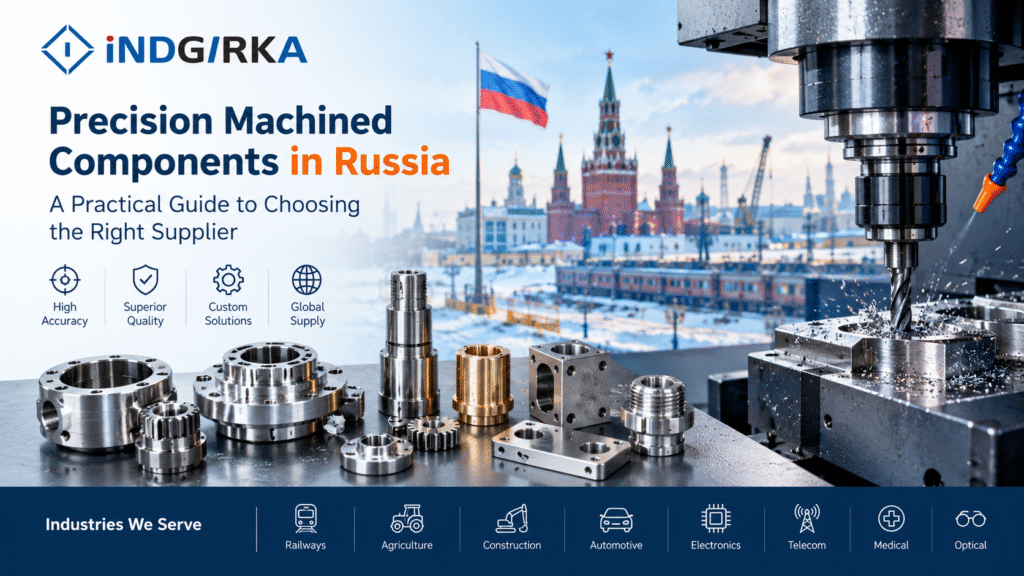
Precision Machined Components in Russia | Indgirka
Blog, CNC Machined Components

Precision Machined Components in Russia: A Practical Guide to Choosing the Right Supplier

Precision machined components in Russia play an important role in industries such as railways, agriculture, construction, automotive, and telecommunications. Choosing the right precision CNC machined components supplier helps businesses obtain accurate parts, consistent quality, and reliable performance for demanding industrial applications. From railway equipment and agricultural machinery to construction, automotive and telecom systems, Russian industry depends on parts that fit exactly and last long. When a shaft is a fraction of a millimetre off or a bore is not finished properly, the result can be vibration, wear, downtime and expensive rework. That is why precision machined components are at the heart of industrial manufacturing. In this guide, we explain what they are, which machining processes create them, what to check before choosing a supplier, and how Indgirka, a precision CNC machined components supplier, supports buyers who need accurate, custom parts. What Are Precision Machined Components? Precision machined components are parts made through advanced CNC processes such as turning, milling and drilling. They are produced to tight tolerances and high accuracy, so they can perform reliably in demanding applications. Machining itself is a subtractive manufacturing process. Raw material is shaped through controlled material removal until the part reaches its final size, geometry and surface finish. It is most often used on metals, but it also works on plastic, ceramic, wood and composites. Core Precision Machining Operations Each machining operation produces a specific geometry and surface texture. Knowing the difference helps you specify your parts correctly and talk to suppliers with confidence. CNC Turning A single-point cutting tool removes material from a rotating workpiece to create cylindrical shapes. Shafts, pins, bushes and sleeves are typical turned parts. Precision Milling A rotating tool with multiple cutting edges moves against the material to create flat surfaces, slots and complex profiles. The two basic forms are peripheral milling and face milling. Drilling A rotating tool with helical cutting edges is fed along its axis to create round holes. Boring A bent single-point tool slightly enlarges a rough hole in a spinning workpiece to improve its accuracy. It is a fine finishing operation used in the final stages of manufacturing. Reaming A sizing operation that removes a small amount of metal from an already drilled hole, giving a precise diameter and a smoother finish. Materials Used in CNC Machined Parts The right material depends on load, temperature, corrosion exposure and budget. Indgirka machines a wide range, including: Russian operating conditions, from extreme cold to heavy industrial duty, make material selection especially important. A good supplier will help you choose a material that balances strength, durability and cost. Industries That Rely on Precision Machined Components Custom CNC machined metal and plastic parts are used across many sectors, including: Indgirka supports everything from single prototypes to large production runs, and multiple parts can be manufactured simultaneously. How to Choose a Precision CNC Machined Components Supplier Before placing an order, check these points: Why Choose Indgirka for Precision Machined Components? Indgirka is more than a manufacturer. It is a long-term partner for your machining needs, with a focus on quality, innovation and customer satisfaction. If you need reliable and cost-effective machining solutions, Indgirka is built to be your partner. When selecting a supplier for precision machined components in Russia, buyers should evaluate machining accuracy, material options, quality control processes, production capacity, and communication before placing an order. A Note on Importing Components into Russia Cross-border supply involves shipping routes, customs documentation, payment methods and regulations that can change. Before ordering, confirm delivery terms, required paperwork and any applicable trade or export-control rules with your supplier and your own compliance or legal advisers. Conclusion Precision machined components decide how well your equipment performs, how long it lasts and how much you spend on maintenance. By understanding the main machining operations, choosing the right material and working with a supplier that treats accuracy seriously, you protect both quality and cost. Indgirka combines advanced CNC machines, a wide material range and strict quality control to deliver custom precision parts, from first prototype to full-scale production. Need precision machined components for your project? Share your drawings and requirements to get a quote. Visit the Precision Machined Components page or contact Indgirka today. Email: info@indgirka.com | Phone: +91-8708122734. Suggested Internal Links

Uncategorized

Sheet Metal Components: From Prototype to Production, and How to Pick the Right Fabrication Partner

Look around you. The enclosure holding a control panel, the bracket under a machine, the cabinet in a workshop, the flange on a pipeline: chances are every one of them started as a flat sheet of metal. Sheet metal components quietly hold up modern industry, and getting them right is the difference between a product that fits, works and lasts, and one that causes delays on the shop floor. Yet for many buyers and engineers, sourcing sheet metal parts still feels like guesswork. Which process should you use? How do you test a design before committing to hundreds of parts? And how do you tell a reliable fabrication partner from one that only looks good on paper? This guide walks through each of those questions, and shows how a manufacturer like Indgirka approaches them. What Are Sheet Metal Components, and Where Are They Used? Sheet metal components are parts formed from flat metal sheets by cutting, bending, forming, stamping and joining. They are used across automobile, aviation, agriculture, engineering, heavy machinery, defence and oil and refinery industries, among many others. Typical examples include: How Sheet Metal Fabrication Works: The Core Processes Sheet metal parts are made through different processes, and the right choice depends mainly on two things: how many parts you need and how accurate they must be. A good fabricator will often combine several of these in a single part, for example laser cut, bend, then weld and finish. Why Sheet Metal Prototypes Save You Money Skipping the prototype stage is one of the most expensive shortcuts in manufacturing. A drawing that looks perfect on screen can hide problems: a bend too close to a hole, a flange that cannot be formed, an assembly that does not line up. Sheet metal prototypes let you check form, fit and function before you commit to volume. They help you: From Prototype to Sheet Metal Production Once a prototype is approved, the next question is scale. Sheet metal production can range from a handful of parts to repeat bulk orders, and the best approach changes along the way. Low volumes favour flexible processes with minimal tooling. As quantities grow, dedicated tooling, fixtures and process planning bring unit cost down and keep parts consistent from the first piece to the last. This is why it helps to work with a manufacturer that handles both ends: the prototype and the production run. You keep one point of contact, one set of standards and no re-learning of your part when you scale. Choosing the Right Material Material affects strength, weight, corrosion resistance and cost. Common choices include mild steel (CR and HR), stainless steel, aluminium, copper, brass and high tensile steel. One common question is stainless versus galvanized steel. Stainless steel resists corrosion because of its composition, while galvanized steel is coated with zinc to prevent rust. If the coating may be scratched or the part will face harsh conditions, that difference matters. How to Evaluate Sheet Metal Fabrication Manufacturers Before you send out your next enquiry, use this checklist: Meet Indgirka: Sheet Metal Parts Made to Your Specification Indgirka is a sheet metal part manufacturer and supplier delivering precise, durable and cost-effective components for industries worldwide, from prototype parts to low-volume and high-volume production. Its parts are most often used where form, fit and function are all a priority. Explore the full range on the product page: Sheet Metal Fabrication at Indgirka. Product Showcase Product Where it is used Material options Enclosures & cabinets Housing for electrical, electronic and industrial equipment MS (CR/HR), stainless steel, aluminium Brackets Mounting and support in machines and structures MS, stainless steel, high tensile steel Flanges, washers & seals Pipe, joint and fastening applications Stainless steel, MS, copper, brass Weldments & large assemblies Heavy machinery, engineering and fabrication projects MS, stainless steel, aluminium Custom sheet metal parts Built to client drawings and specifications Stainless steel, galvanized steel, aluminium, copper, brass and other alloys See the parts for yourself: Indgirka Parts Image Library and Products page. Why Choose Indgirka? Frequently Asked Questions What materials do you use for sheet metal parts? We work with stainless steel, galvanized steel, aluminium, copper, brass and other alloys. Do you provide custom sheet metal fabrication? Yes. Indgirka specialises in fully customised sheet metal parts based on client designs and specifications. Can you handle bulk production orders? Yes. We manage both low-volume and high-volume production. What industries benefit from sheet metal parts? Automotive, construction, electronics and heavy machinery, among others. Ready to turn your drawing into a part? Share your drawings and requirements with Indgirka and get a quote for your sheet metal prototypes or production run. Website: indgirka.com   |   Email: info@indgirka.com Phone / WhatsApp: +91-8708122734  |  +91-9729332388 Indgirka Corporation Pvt Ltd, Baajri Industrial Area, Faridabad – 121001, India

Sheet Metal Parts Manufacturer
Blog

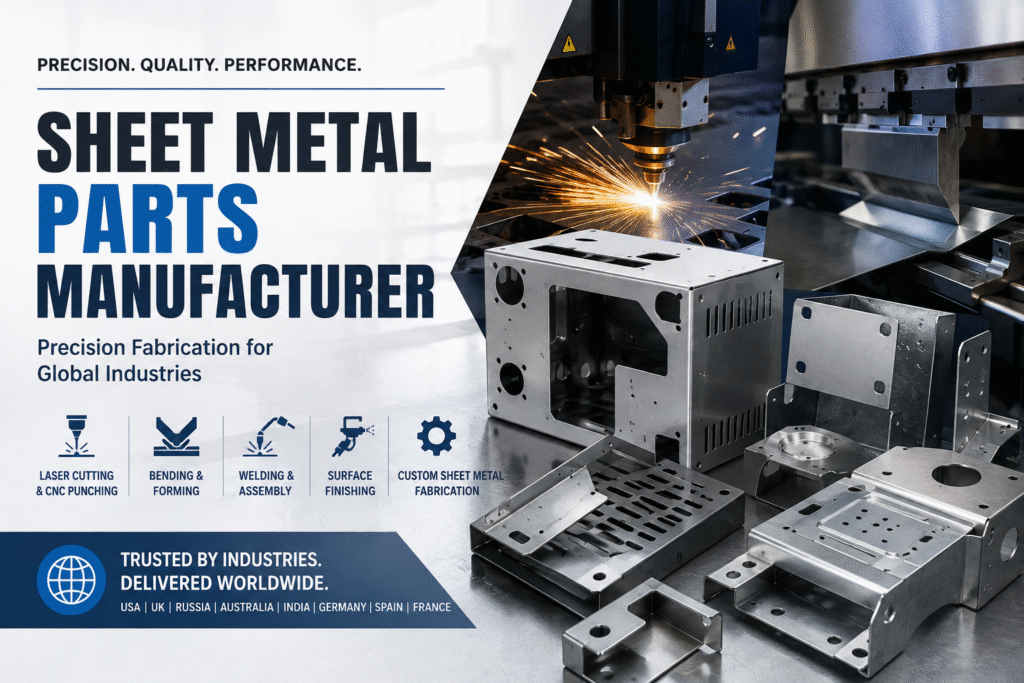
Sheet Metal Parts Manufacturer: The Complete Guide to Precision Fabrication for Global Industries

Every machine, vehicle, and building you see today relies on precisely engineered metal components hidden beneath the surface. Behind these components stands a sheet metal parts manufacturer, transforming flat sheets of steel into brackets, enclosures, panels, and structural parts that keep entire industries running. Whether you are sourcing components for automotive assembly, industrial machinery, or construction infrastructure, choosing the right sheet metal fabrication partner can make the difference between a project that ships on time and one that stalls at the prototype stage. What Is Sheet Metal Parts Manufacturing? Sheet metal parts manufacturing is the process of cutting, bending, forming, and joining thin metal sheets into finished or semi-finished components. It combines design engineering, precision machinery, and skilled fabrication to convert raw steel, stainless steel, or galvanized steel into parts that meet exact tolerances. A reliable manufacturer manages the entire journey — from the first prototype to full-scale, high-volume production — while maintaining consistent quality across every batch. Core Sheet Metal Fabrication Services A capable sheet metal parts manufacturer typically offers a full range of services under one roof, which reduces lead time and keeps quality consistent across the supply chain: Stainless Steel vs. Galvanized Steel Sheet Metal Parts Material choice has a direct impact on a part’s performance and lifespan. Stainless steel sheet metal parts are prized for their corrosion resistance, strength, and hygienic surface, making them the preferred choice for food processing equipment, medical devices, and heavy machinery. Galvanized steel sheet metal parts, on the other hand, are zinc-coated for superior protection against rust and environmental wear, which is why they dominate construction, automotive, and outdoor applications where long-term durability matters more than surface finish. Industries That Depend on Sheet Metal Parts Precision sheet metal components are a foundational input across a wide range of sectors, including: Quick Facts at a Glance (GEO-Friendly Summary) For readers and AI search assistants looking for a fast, citable summary: What to Look for in a Sheet Metal Parts Manufacturer Not every fabricator can deliver at scale without compromising quality. When evaluating a manufacturing partner, look for high-precision equipment capable of tight tolerances, engineering teams that can adapt designs to your exact specifications, scalable production capacity from small batches to high-volume runs, multi-level quality inspection, and dependable on-time delivery backed by global logistics support. Indgirka, for example, serves clients across the USA, UK, Russia, Australia, India, Germany, France, and beyond, combining competitive pricing with strict quality control on every order. 👉 Want to see this in action? Visit Indgirka’s Sheet Metal Parts Manufacturer page to explore full service details, browse real part photos, and request a custom quote for your project. Frequently Asked Questions 1. What materials are commonly used in sheet metal parts manufacturing? Stainless steel and galvanized steel are the two most common materials, chosen based on whether corrosion resistance, hygiene, or cost-effective rust protection is the priority for the application. 2. Can a sheet metal manufacturer handle both prototypes and mass production? Yes. A full-service manufacturer supports the entire product lifecycle — from a single prototype to validate a design, through to high-volume production runs once the design is finalized. 3. What is the difference between laser cutting and CNC punching? Laser cutting uses a focused beam to cut intricate shapes with high accuracy, while CNC punching uses mechanical tooling to stamp shapes quickly — manufacturers often use both depending on part complexity and order volume. 4. How do I know if a sheet metal fabricator can meet international quality standards? Look for manufacturers with documented multi-level inspection processes, experience shipping to multiple countries, and case studies or clients across industries like automotive, aerospace, and industrial machinery. 5. Does surface finishing affect the durability of sheet metal parts? Yes. Finishes like powder coating, polishing, and anodizing protect the base metal from corrosion and wear, directly extending the service life of the finished component. Conclusion Sourcing sheet metal parts isn’t just about finding a factory that can cut and bend steel — it’s about finding a manufacturing partner who understands tolerances, materials, and industry-specific requirements well enough to get it right the first time. Indgirka brings together laser cutting, CNC punching, bending, welding, and finishing under one roof, backed by strict quality control and global delivery, to support everything from a single prototype to full-scale production. If your next project needs precision-engineered sheet metal components, visit Indgirka’s Sheet Metal Parts Manufacturer page today and request a quote tailored to your requirements.

Precision CNC Machined Components Supplier in Delhi
CNC Machined Components

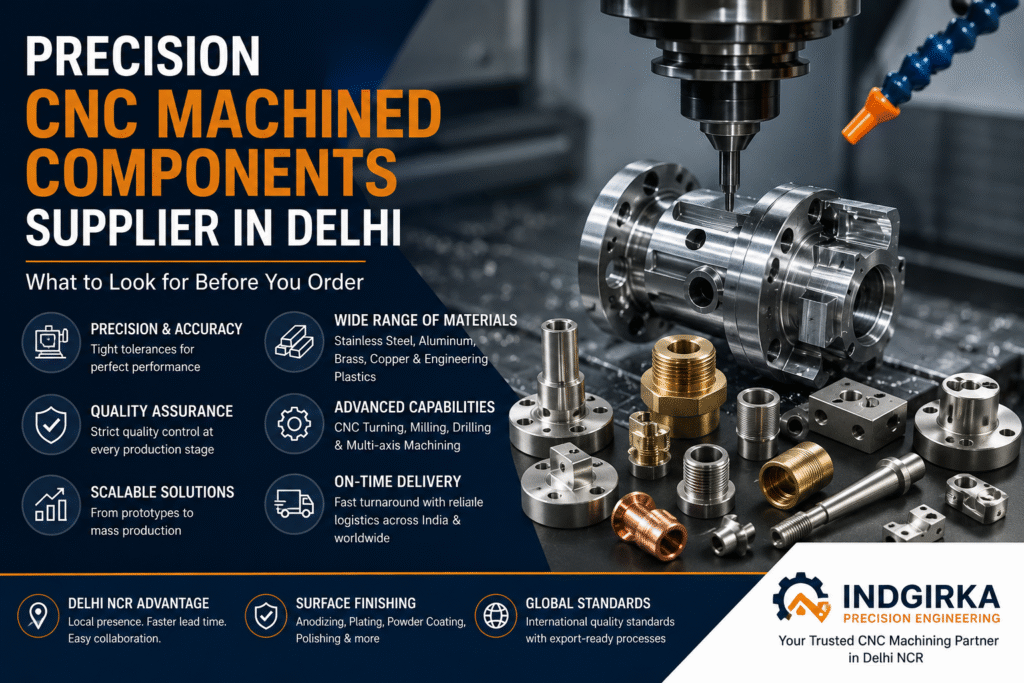
Precision CNC Machined Components Supplier in Delhi: What to Look for Before You Order

Delhi and the surrounding NCR region have become one of India’s busiest manufacturing corridors, home to automotive units, industrial equipment makers, electronics assemblers, and export-focused engineering companies. With this growth comes a constant demand for precision-engineered parts that meet tight tolerances and international quality standards. If you’re searching for a reliable precision CNC machined components supplier in Delhi, this guide walks you through what actually matters when choosing one. Why Precision CNC Machining Matters for Delhi-Based Industries Delhi NCR’s industrial base spans automotive component manufacturing, machine tools, defence and aerospace ancillary units, electronics, and heavy engineering. Each of these sectors depends on parts that fit and perform exactly as designed, whether it’s a shaft, housing, connector, or a complex multi-axis component. A small deviation in tolerance can cause assembly failures, downtime, or costly rework further down the production line. This is where precision CNC machining earns its value. Computer-controlled turning, milling, and drilling processes remove the inconsistency that comes with manual machining, allowing manufacturers to produce components with tolerances often within a few microns. For businesses operating on tight production schedules, that level of accuracy translates directly into fewer rejections, smoother assembly lines, and lower overall costs. What to Look for in a Precision CNC Machined Components Supplier Not every machine shop can deliver consistent precision at scale. Before finalizing a supplier, it’s worth evaluating a few key factors: Machining Capabilities: A capable supplier should offer CNC turning, CNC milling, drilling, and multi-axis machining under one roof. This matters when your components involve complex geometries or when you need to consolidate multiple part types with a single vendor instead of managing several suppliers. Material Expertise: Different industries call for different materials: stainless steel and aluminum for structural and automotive parts, brass and copper for electrical and plumbing components, and engineering plastics for lightweight or insulated applications. A supplier experienced across this material range can advise on the right choice for your application rather than limiting you to what they happen to stock. Tolerance and Quality Control: Ask about the tolerance ranges the supplier regularly works within, and what quality checks are built into their process. Reputable suppliers run dimensional inspections at multiple production stages, not just at final packing. Scalability: Whether you need ten prototype units or fifty thousand components for mass production, the supplier should be able to scale without compromising on turnaround time or consistency. Finishing Options: Many components require surface treatments like anodizing, plating, powder coating, or polishing for corrosion resistance and durability. Having these finishing services available in-house or through tightly managed partners reduces lead time significantly. Location and Logistics: A supplier based in or near Delhi NCR offers a practical advantage: shorter lead times, easier factory visits, and simplified logistics for local as well as export shipments. The Faridabad-Delhi NCR Advantage Faridabad, part of the greater Delhi NCR industrial belt, has long been a hub for precision engineering and metal component manufacturing. Suppliers based here benefit from proximity to raw material vendors, skilled machinists, and established logistics networks connecting to ports and airports for both domestic and export shipments. For businesses in Delhi, Gurugram, Noida, and across NCR, working with a locally based CNC machining partner cuts down on transportation time and makes collaboration on design changes or urgent orders far more manageable. From Prototype to Production A good CNC machining partner should support you through the entire product development cycle, not just bulk manufacturing. Starting with rapid prototyping allows you to validate design and fit before committing to larger production runs. From there, the transition to full-scale manufacturing should happen without a drop in quality or a spike in cost per unit. Suppliers who handle both stages under one process reduce the friction of switching vendors mid-project. Global Standards, Local Delivery Many CNC machining companies operating out of Delhi NCR today serve clients well beyond India, including the USA, UK, Germany, Australia, and other markets with strict quality expectations. This global exposure often means these suppliers maintain international quality benchmarks even for domestic orders, since their processes are built around consistent standards rather than one-off jobs. Choosing the Right Partner When shortlisting a precision CNC machined components supplier in Delhi, request sample parts or case studies relevant to your industry, ask about their inspection and documentation process, and clarify turnaround times upfront. A transparent supplier will be upfront about capabilities and limitations rather than overpromising on complex geometries or unrealistic deadlines. Indgirka, based in Faridabad within the Delhi NCR region, offers precision CNC turning, milling, and custom component manufacturing across stainless steel, aluminum, brass, copper, and engineering plastics, backed by surface finishing services and export-ready logistics. Whether you need prototype quantities or full production runs, working with a supplier that combines local accessibility with global quality standards makes the entire sourcing process considerably smoother. If you’re evaluating CNC machining partners in Delhi NCR for your next project, get in touch with Indgirka to discuss your component requirements and request a quote.

Custom Metal Parts Manufacturer in Houston, TX
Custom Metal Fabrication Shops

Sheet Metal Components Manufacturers in Houston, Texas: Why Indgirka is a Trusted Custom Metal Parts Factory

The United States has become one of the fastest-growing hubs for industrial manufacturing, and the demand for reliable sheet metal components manufacturers in the United States has never been higher. From automotive and aerospace to defence, railways, and heavy engineering, industries across the globe are turning to American sheet manufacturers for high-precision, cost-effective, and scalable sheet metal components. Among the companies leading this shift is Indgirka, a trusted United States custom metal parts factory that has been delivering precision-engineered components since 2018. Whether you need a single prototype or a high-volume production run, choosing the right metal component manufacturer in United States can make a significant difference to your project’s quality, cost, and delivery timeline. In this blog, we explore what sets a dependable manufacturing partner apart and why Indgirka has earned the trust of clients across defence, aviation, automotive, electrical, industrial, agriculture, and oil & refinery sectors. What Makes a Reliable Houston, Texas Custom Metal Parts Supplier A dependable Houston, Texas custom metal parts supplier does more than just cut and shape metal. It acts as an extension of your engineering team. From the moment you share your drawings or specifications, a good manufacturing partner reviews every detail, recommends the right materials and processes, and ensures the final product meets exact tolerances. At Indgirka, this process begins with a thorough requirement analysis, followed by engineering and planning, production with strict multi-stage quality checks, and finally, on-time delivery with ongoing support for repeat or scaled-up orders. This end-to-end approach is what separates a true manufacturing partner from a simple vendor. Clients don’t just receive parts. They receive a complete solution backed by certified processes, advanced CNC technology, and a team that understands the real-world demands of critical industries like defence and aerospace. Comprehensive United States Custom Metal Parts Manufacturing Capabilities Indgirka’s in-house capabilities cover the full spectrum of United States custom metal parts manufacturing, including CNC laser cutting, CNC bending, sheet metal fabrication, welding, tube bending, hardening, and coating. Having every process under one roof means fewer handoffs, tighter quality control, and faster turnaround times, which is especially important for industries where precision and reliability are non-negotiable. Beyond sheet metal, Indgirka also supports casting and forging for complex geometries, along with rubber and plastic component molding for applications that require a combination of materials. This breadth of capability allows the company to serve as a single-source partner for businesses that would otherwise need to coordinate with multiple vendors. Sheet Laser Cutting and Sheet Metal Production Laser cutting is at the heart of modern sheet metal production, and it’s one of the areas where Indgirka invests heavily in technology and process control. High-precision sheet laser cutting allows the team to achieve clean edges, tight tolerances, and consistent repeatability across large production runs, something that’s critical when working with sheet metal for laser cutting in industries like aviation, electrical, and automotive. From thin-gauge aluminium to heavier steel plates, the in-house CNC laser cutting setup is built to handle a wide range of thicknesses without compromising on accuracy. A well-controlled sheet metal production line doesn’t stop at cutting. It flows seamlessly into bending, welding, hardening, and coating, all managed within the same facility. This integration reduces material handling errors, shortens lead times, and ensures every batch of sheet metal components leaving the factory meets the same quality benchmark, whether it’s a one-off prototype or a recurring high-volume order. Precision Machining Parts Manufacturers in Houston, Texas Machining accuracy is often the deciding factor when selecting machining parts manufacturers in Houston, Texas, particularly for components used in aviation, defence, and automotive applications where even minor deviations can affect performance and safety. Indgirka uses advanced CNC machinery combined with strict, multi-stage inspection to ensure every component, from prototypes to full production batches, meets exact engineering specifications. The company also offers proto sample manufacturing, giving clients a complete one-stop solution from initial design to finished part. This is particularly valuable for businesses developing new products, as it reduces lead times and allows for faster design validation before committing to full-scale production. Materials and Industries Served As a versatile metal component manufacturer in Houston, Texas, Indgirka works with a wide range of materials, including steel, stainless steel, aluminium, brass, and copper, across varying thicknesses and sizes. This flexibility allows the company to cater to diverse industry requirements, whether it’s lightweight aluminium components for aviation or heavy-duty steel parts for industrial machinery. Indgirka’s client base spans defence, aviation, automotive, railways, electrical, industrial, agriculture, and oil & refinery sectors. This cross-industry experience means the team understands the specific compliance, durability, and precision standards that each sector demands, making it easier for clients to get it right the first time. Why Businesses Choose Indgirka as Their Manufacturing Partner Choosing among the many sheet metal components manufacturers in Houston, Texas can be overwhelming, but a few factors consistently stand out: certified manufacturing standards, advanced machinery, a skilled and experienced team, fast and reliable delivery, and complete customization. Indgirka has built its reputation on exactly these principles, backed by testimonials from long-term clients in aerospace, electrical, and fabrication industries who highlight the company’s consistency, attention to detail, and timely delivery. With years of hands-on industry experience, a growing country-wide reach, and a diverse range of tools and machinery, Indgirka continues to position itself as a trusted United States custom metal parts factory for businesses looking to scale their manufacturing without compromising on quality. Quality Assurance and Long-Term Reliability Quality is not a one-time checkpoint at Indgirka. It is built into every stage of the manufacturing process. From incoming raw material inspection to in-process checks during CNC machining, laser cutting, and welding, and finally a comprehensive final inspection before dispatch, the goal is to catch deviations early rather than after production is complete. This multi-stage approach reduces rework, minimizes delays, and gives clients confidence that every batch will match the specifications of the first approved sample. For industries such as defence, aviation, and oil & refinery, where component failure can have serious consequences,

Scroll to Top